Why “More Attractions” Is No Longer Enough
Family entertainment centers are changing fast. Today, guests are not just looking for a single activity — they’re looking for experiences that feel social, competitive, interactive, and worth coming back for.
That’s exactly the direction Poort51 in Weert, Netherlands, wanted to take.
Built inside the transformed “Poort van Limburg” complex, Poort51 was designed as a modern multi-attraction entertainment venue combining bowling, mini golf, interactive games, and group activities under one roof. As part of that vision, the venue partnered with Intelligent Entertainment to install a full 20-mission Agent Factory arena.
But this wasn’t simply about adding another attraction.
The goal was to introduce something that could:
- work for groups,
- create repeat visits,
- fit naturally into the venue flow,
- and add a more competitive, high-energy layer to the overall experience.
The Real Challenge: Making AF Work Inside a Busy Multi-Activity Venue
One of the interesting parts of the project was how Agent Factory had to fit into an already active entertainment environment.
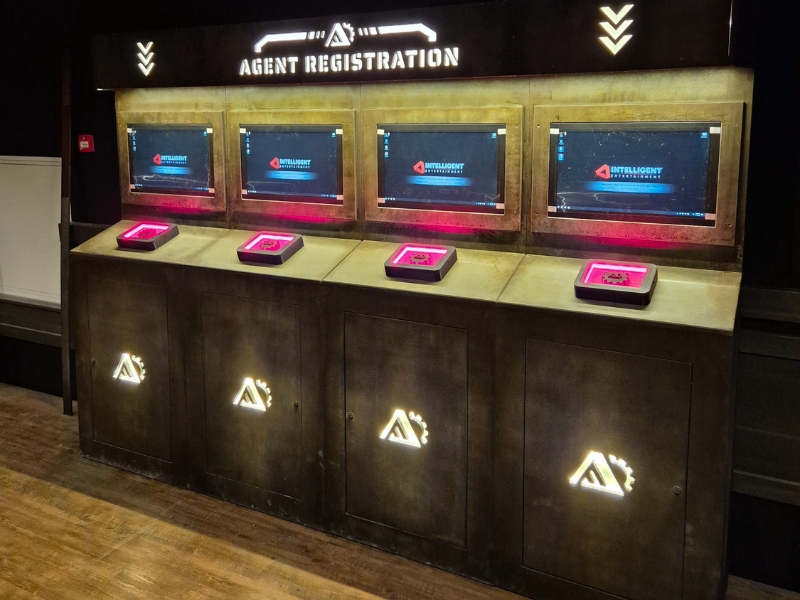
The AF arena was installed on the upper floor of Poort51, right next to the mini golf area. Guests walking toward mini golf naturally pass in front of the AF entrance and registration area, meaning the attraction became part of the venue’s overall circulation flow rather than a completely isolated zone.
That also created some practical challenges during planning.
For example, the registration kiosk had to be moved from its original planned position after discussions with the client. Decorative AF signage in the corridor was also reduced because the same corridor functions as a shared pathway toward other attractions.
These are the kinds of real-world details that matter in multi-attraction venues. It’s not only about designing the attraction itself — it’s about making sure everything works together operationally.
20 Missions. Around 20 Days. Inside an Existing Venue.
According to the project managers involved, the full installation process took roughly 20 days from on-site start to launch readiness.
Interestingly, the team said the most time-consuming phase was not the installation itself, but the preparation beforehand:
- planning,
- logistics,
- technical coordination,
- and adapting the design to the venue.
The project also highlighted how important accurate venue documentation is in retrofit projects.
During the installation of the “Find the Evidence” mission, the team encountered curved walls and door structures that were not fully visible in the original material provided beforehand. Additional on-site adaptation work was needed to integrate the mission properly into the space.
The upper-floor location of the arena also created logistical concerns at first, especially regarding narrow corridors and transporting props into the rooms. In the end, however, the installation team reported that the transportation and setup process went more smoothly than expected.
What the Team Learned After Opening
Like most technology-driven attractions, some of the most valuable insights only appeared once the venue became operational.
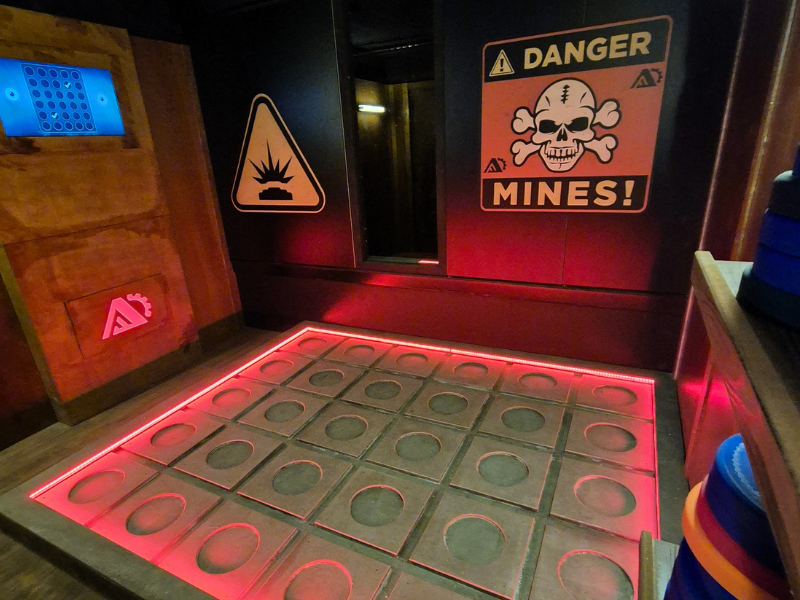
According to the project managers, missions using LiDAR floor sensors require the most operational attention from staff to ensure sensors function correctly and avoid unintended “random hits” during gameplay.
Another important focus during testing was Alfredo’s Pizza, one of the newest missions included in the installation. Because the mission was newly introduced, it required more testing and calibration before opening. The team noted, however, that the mission ultimately performed better than expected during live testing.
These operational details may sound small, but they are exactly the kinds of lessons that help improve future installations and long-term venue performance.
Why Projects Like This Matter for the Future of FECs
For venue operators and investors, the Poort51 project represents something bigger than simply installing a new game attraction.
It reflects a broader shift happening across the leisure industry:
modern venues increasingly need attractions that are:
- replayable,
- group-friendly,
- operationally scalable,
- and easy to integrate into larger entertainment ecosystems.
That’s where concepts like Agent Factory become especially interesting. Instead of functioning as a one-time experience, the attraction becomes part of the venue’s overall social and competitive energy.
The Poort51 project also demonstrated that large-scale mission-based attractions can be integrated efficiently into existing multi-attraction venues, even with real-world spatial and operational constraints.
With the right preparation and coordination, the project showed that a full 20-mission installation could be completed quickly while still adapting to the realities of a live entertainment environment.
As entertainment venues continue moving toward more social, replayable, and experience-driven formats, projects like Poort51 offer a practical example of what the next generation of family entertainment centers may increasingly look like.
Want to see how Agent Factory could fit into your venue?
Send us your floorplan and we’ll create a free custom AF layout concept for your space.
Or book a demo call with us to find out more!


